Sometimes I receive a review, which gives me goosebumps and makes me a little teary. Thanks so much to reviewer Linda Townsend!
Reading Between the Wines Book Club: Audio #Review: Harvest of Dreams by Debra Holland - 5 Wine Glasses
Wednesday, December 3, 2014


Tuesday, December 2, 2014
Monday, November 24, 2014
MY FIRST GERMAN TRANSLATION--A TRIBUTE TO MY GRANDMOTHER!!!
My grandmother, Martha
Muth Junger, was a huge inspiration for my writing. When I was little, she'd
tell me stories of her childhood, growing up on a big estate in Germany. Martha was the
fifth (living) daughter of a large family, and her parents were divorced, which was unusual
for those days. She had a strict governess who later became her stepmother.
Martha ran wild and often found herself in trouble, being chased by a bull,
climbing the barn roof to explore the stork nest, getting sick from stealing
her father's pipe and smoking it, running away to the Gypsies to have her
fortune told.
I often stayed with my
Omi (as I called her.) In the morning, I'd crawl into bed with her, and she'd
tell me stories, not just her own, but those of her father and her grandmother. Even at that young age, I
knew I wanted to write her stories when I grew up.
But first I went to
school, and school, and school. Not until after I recovered from obtaining my
Masters Degree and Ph.D, did I start to work on that old dream of writing down
Omi's stories. But by that time, she was older and had forgotten many of the
details I needed to write a biography. So I took my favorites and wrote several
short stories. After a computer crash (my very first computer,) I learned why it
was important to back up your files, and I lost a lot of my research. But I
continued writing short stories about my grandmother and started taking writing
classes. And I joined a critique group led by a writing teacher.

In the last year of Omi's
life, I started writing my first novel, Wild Montana Sky, and she died before I
finished the book. Although I wish I could place a copy in her hands, I have no
doubt that she's still present in my life. Parts of her stories have made their
way into my Montana Sky Series books--not what I'd imagined writing when I was a child,
but perhaps even better.
For the last few years,
I've wanted my books translated into German, both as a tribute to my beloved
Omi, but also for the German members of my family to be able to read my books.
So today, with great joy and a few tears for Omi, I announce the
release of Der wilde Himmel über Montana, my first German book.

Monday, October 27, 2014
GLORIOUS MONTANA SKY--FROM DREAM TO REALITY
Sometimes an author carries a
story around in her head for years before she actually has a chance to write
it. Such was the case for me with Glorious Montana Sky. I can’t tell you when the idea for the story of Joshua Norton,
son of Reverend Norton (the minister in my small Montana town) and his wife
Mary, came about. I do know I started formulating the story about three years
ago.

The first scene that came to me
and I wrote down at the time was between Joshua and his father. In the scene,
Joshua, a missionary who’d just returned from Africa after the death of his
wife, was telling his father about his feelings of burnout. (But since it’s
1895, I couldn’t use the word “burnout.”)
As I wrote this scene, another
character came into being—Joshua’s nine-year-old son, Micah. Joshua told his
father how Micah had run wild for the previous year because his mother was
dying. The boy bonded with the African natives, whom he considered family, and
was grieving and resentful about leaving them. Joshua had been focused on
caring for his wife and neglected his son. So his relationship with Micah is
strained.
Ah, two hurting men or, rather, a
man and a boy. I had to find a partner for Joshua—a woman who’d both challenge
him and help him heal, one who’d bond with Micah and help him adjust to living
in Sweetwater Springs, Montana.
A definite challenge for I had no
character in Sweetwater Springs who would fit for Joshua. Therefore, I had to
bring her from somewhere else. So the idea of Delia Fortier, a quadroon woman
fleeing New Orleans with her father, came to me. I knew he’d have a heart
attack on the train, forcing the two to stay in Sweetwater Springs while he
recovered. Delia has a secret that she hides from Joshua—the reason she and her
father left New Orleans. This secret will keep her and Joshua apart and may
even threaten their lives.
With the idea for the book firmly
in my mind, I wrote down my notes. I commissioned Delle Jacobs, my cover
designer, to do the cover for Glorious Montana Sky, telling her I wanted a sweeping sky scene with a train in the
distance. We played with the size and angle of the train, and I settled on a
small barely seen version.
Then I set the story aside and
focused on writing Painted Montana Sky
and Montana Sky Christmas, both
smaller books that I could write quicker than the longer story for Glorious
Montana Sky. Then I had the idea for The
Mail-Order Brides of the West subseries, and wrote three of those books.
So Glorious Montana Sky had plenty of time to simmer in my mind. In
the years since thinking of the story and writing it, I would have ideas or
bits of dialogue come to me. Often this happened in church during the sermon.
One of the ministers at my church was a missionary and also grew up on a farm
in North Dakota. Sometimes he’d tell a story that had me scribbling notes on my
bulletins. When it came time to write the book, I had a stack of church
bulletins to go through.
A week ago, I received my author
copies of Glorious Montana Sky.
Holding the book in my hand, with the beautiful cover designed three years ago,
I had a huge sense of accomplishment—a dream that was three years old was now a
reality. What a wonderful feeling!
YOU’RE INVITED TO MY FACEBOOK LAUNCH PARTY
On Thursday, October 30th,
from 3:00-6:00 EST, I’m throwing a Facebook party for the release of Glorious Montana Sky. Joining me will be authors: Julianne Maclean, Laura Drake,
Catherine Bybee, Kat Martin, Pat Wright, RJ Sullivan, Sarah Woodbury, Joan
Wolf, and Caroline Fyffe. Each author will have his or her own 20 minute
segment, but I’ll be there the whole time, and I’ll have other authors dropping
in. We’ll have plenty of giveaways—signed books, small gift cards, and the
ultimate prize of a Kindle Fire (selected randomly from all the commenters of
the day.)
Sunday, October 5, 2014
Friday, August 8, 2014
A LETTER FROM AMAZON TO THEIR INDIE AUTHORS CONCERNING THE HACHETTE NEGOTIATIONS
In this battle between Amazon and Hachette, I'm siding with Amazon, not only because I'm a
Montlake Romance author and a self-published author, but because I've
been closely following (as much as possible) the information and
discussions about this situation and feel Amazon is (for the most part) in the right. I'm very concerned about my colleagues
who write for Hachette. They are truly the ones suffering because their
publisher is using them as canon fodder. (Although many of them don't
realize Hachette has thrust them into the front lines, and they are blaming Amazon for the war.)
Please don't throw the "Amazon is not your friend" comment at me. I already know that. Amazon is a business--one that has changed my life for the better. I'm deeply grateful to the company, but that doesn't mean I'm blindly on Amazon's side.
What I am against is paying high prices for ebooks. However the dust falls from the giants duking out the contract, I will NOT buy high priced ebooks. I don't care who publishes them or if they are written by my favorite authors. For me, it a matter of principle. I feel it's WRONG for publishers to charge a high price for an ebook, and that they are just trying to GOUGE the reader. Sometimes, it's really hard not to press that buy button on a book I really want. At those times, I feel resentment at the publisher who controls the pricing. But then I browse the Amazon or iBooks website and find something else to read--something affordable. There are always other books. :)
When I say "affordable" that's perhaps misleading. Thanks to Amazon, I'm in a position to afford to read whatever I want, regardless of the price. But I won't. Perhaps it's from too many years where I could never afford enough books. I out-read my types of books at the city and school library. I haunted used books stores and garage sales for paperback books I could buy for .25 or .50. Sometimes, it still feels like a luxury to go on an ebook "shopping spree" or pay a high price for a hardback book that only takes me a few hours to read.
There are a lot of people out there like me--avid readers who speed through books and can never have enough of their favorite type of stories. Many of those readers cannot afford to feed their habit--or they couldn't before so many free and low price ebooks came on the market--again due to Amazon.
There are many, many, many inexpensive books out there, and readers will buy them, find new authors to love and auto-buy, and drift away from old favorites whom they cannot afford (or don't want to afford.) Then both author and publisher will lose.
Debra Holland, Ph.D
New York Times and USA Today Bestselling Author
From: Kindle Direct Publishing
Subject: Important Kindle request
Date: August 8, 2014 at 10:12:34 PM PDT
To: Debra Holland
Dear KDP Author,
Just ahead of World War II, there was a radical invention that shook the foundations of book publishing. It was the paperback book. This was a time when movie tickets cost 10 or 20 cents, and books cost $2.50. The new paperback cost 25 cents – it was ten times cheaper. Readers loved the paperback and millions of copies were sold in just the first year.
With it being so inexpensive and with so many more people able to afford to buy and read books, you would think the literary establishment of the day would have celebrated the invention of the paperback, yes? Nope. Instead, they dug in and circled the wagons. They believed low cost paperbacks would destroy literary culture and harm the industry (not to mention their own bank accounts). Many bookstores refused to stock them, and the early paperback publishers had to use unconventional methods of distribution – places like newsstands and drugstores. The famous author George Orwell came out publicly and said about the new paperback format, if “publishers had any sense, they would combine against them and suppress them.” Yes, George Orwell was suggesting collusion.
Well… history doesn’t repeat itself, but it does rhyme.
Fast forward to today, and it’s the e-book’s turn to be opposed by the literary establishment. Amazon and Hachette – a big US publisher and part of a $10 billion media conglomerate – are in the middle of a business dispute about e-books. We want lower e-book prices. Hachette does not. Many e-books are being released at $14.99 and even $19.99. That is unjustifiably high for an e-book. With an e-book, there’s no printing, no over-printing, no need to forecast, no returns, no lost sales due to out of stock, no warehousing costs, no transportation costs, and there is no secondary market – e-books cannot be resold as used books. E-books can and should be less expensive.
Perhaps channeling Orwell’s decades old suggestion, Hachette has already been caught illegally colluding with its competitors to raise e-book prices. So far those parties have paid $166 million in penalties and restitution. Colluding with its competitors to raise prices wasn’t only illegal, it was also highly disrespectful to Hachette’s readers.
The fact is many established incumbents in the industry have taken the position that lower e-book prices will “devalue books” and hurt “Arts and Letters.” They’re wrong. Just as paperbacks did not destroy book culture despite being ten times cheaper, neither will e-books. On the contrary, paperbacks ended up rejuvenating the book industry and making it stronger. The same will happen with e-books.
Many inside the echo-chamber of the industry often draw the box too small. They think books only compete against books. But in reality, books compete against mobile games, television, movies, Facebook, blogs, free news sites and more. If we want a healthy reading culture, we have to work hard to be sure books actually are competitive against these other media types, and a big part of that is working hard to make books less expensive.
Moreover, e-books are highly price elastic. This means that when the price goes down, customers buy much more. We've quantified the price elasticity of e-books from repeated measurements across many titles. For every copy an e-book would sell at $14.99, it would sell 1.74 copies if priced at $9.99. So, for example, if customers would buy 100,000 copies of a particular e-book at $14.99, then customers would buy 174,000 copies of that same e-book at $9.99. Total revenue at $14.99 would be $1,499,000. Total revenue at $9.99 is $1,738,000. The important thing to note here is that the lower price is good for all parties involved: the customer is paying 33% less and the author is getting a royalty check 16% larger and being read by an audience that’s 74% larger. The pie is simply bigger.
But when a thing has been done a certain way for a long time, resisting change can be a reflexive instinct, and the powerful interests of the status quo are hard to move. It was never in George Orwell’s interest to suppress paperback books – he was wrong about that.
And despite what some would have you believe, authors are not united on this issue. When the Authors Guild recently wrote on this, they titled their post: “Amazon-Hachette Debate Yields Diverse Opinions Among Authors” (the comments to this post are worth a read). A petition started by another group of authors and aimed at Hachette, titled “Stop Fighting Low Prices and Fair Wages,” garnered over 7,600 signatures. And there are myriad articles and posts, by authors and readers alike, supporting us in our effort to keep prices low and build a healthy reading culture. Author David Gaughran’s recent interview is another piece worth reading.
We recognize that writers reasonably want to be left out of a dispute between large companies. Some have suggested that we “just talk.” We tried that. Hachette spent three months stonewalling and only grudgingly began to even acknowledge our concerns when we took action to reduce sales of their titles in our store. Since then Amazon has made three separate offers to Hachette to take authors out of the middle. We first suggested that we (Amazon and Hachette) jointly make author royalties whole during the term of the dispute. Then we suggested that authors receive 100% of all sales of their titles until this dispute is resolved. Then we suggested that we would return to normal business operations if Amazon and Hachette’s normal share of revenue went to a literacy charity. But Hachette, and their parent company Lagardere, have quickly and repeatedly dismissed these offers even though e-books represent 1% of their revenues and they could easily agree to do so. They believe they get leverage from keeping their authors in the middle.
We will never give up our fight for reasonable e-book prices. We know making books more affordable is good for book culture. We’d like your help. Please email Hachette and copy us.
Hachette CEO, Michael Pietsch: Michael.Pietsch@hbgusa.com
Copy us at: readers-united@amazon.com
Please consider including these points:
- We have noted your illegal collusion. Please stop working so hard to overcharge for ebooks. They can and should be less expensive.
- Lowering e-book prices will help – not hurt – the reading culture, just like paperbacks did.
- Stop using your authors as leverage and accept one of Amazon’s offers to take them out of the middle.
- Especially if you’re an author yourself: Remind them that authors are not united on this issue.
Thanks for your support.
The Amazon Books Team
P.S. You can also find this letter at www.readersunited.com
Please don't throw the "Amazon is not your friend" comment at me. I already know that. Amazon is a business--one that has changed my life for the better. I'm deeply grateful to the company, but that doesn't mean I'm blindly on Amazon's side.
What I am against is paying high prices for ebooks. However the dust falls from the giants duking out the contract, I will NOT buy high priced ebooks. I don't care who publishes them or if they are written by my favorite authors. For me, it a matter of principle. I feel it's WRONG for publishers to charge a high price for an ebook, and that they are just trying to GOUGE the reader. Sometimes, it's really hard not to press that buy button on a book I really want. At those times, I feel resentment at the publisher who controls the pricing. But then I browse the Amazon or iBooks website and find something else to read--something affordable. There are always other books. :)
When I say "affordable" that's perhaps misleading. Thanks to Amazon, I'm in a position to afford to read whatever I want, regardless of the price. But I won't. Perhaps it's from too many years where I could never afford enough books. I out-read my types of books at the city and school library. I haunted used books stores and garage sales for paperback books I could buy for .25 or .50. Sometimes, it still feels like a luxury to go on an ebook "shopping spree" or pay a high price for a hardback book that only takes me a few hours to read.
There are a lot of people out there like me--avid readers who speed through books and can never have enough of their favorite type of stories. Many of those readers cannot afford to feed their habit--or they couldn't before so many free and low price ebooks came on the market--again due to Amazon.
There are many, many, many inexpensive books out there, and readers will buy them, find new authors to love and auto-buy, and drift away from old favorites whom they cannot afford (or don't want to afford.) Then both author and publisher will lose.
Debra Holland, Ph.D
New York Times and USA Today Bestselling Author
From: Kindle Direct Publishing
Subject: Important Kindle request
Date: August 8, 2014 at 10:12:34 PM PDT
To: Debra Holland
Dear KDP Author,
Just ahead of World War II, there was a radical invention that shook the foundations of book publishing. It was the paperback book. This was a time when movie tickets cost 10 or 20 cents, and books cost $2.50. The new paperback cost 25 cents – it was ten times cheaper. Readers loved the paperback and millions of copies were sold in just the first year.
With it being so inexpensive and with so many more people able to afford to buy and read books, you would think the literary establishment of the day would have celebrated the invention of the paperback, yes? Nope. Instead, they dug in and circled the wagons. They believed low cost paperbacks would destroy literary culture and harm the industry (not to mention their own bank accounts). Many bookstores refused to stock them, and the early paperback publishers had to use unconventional methods of distribution – places like newsstands and drugstores. The famous author George Orwell came out publicly and said about the new paperback format, if “publishers had any sense, they would combine against them and suppress them.” Yes, George Orwell was suggesting collusion.
Well… history doesn’t repeat itself, but it does rhyme.
Fast forward to today, and it’s the e-book’s turn to be opposed by the literary establishment. Amazon and Hachette – a big US publisher and part of a $10 billion media conglomerate – are in the middle of a business dispute about e-books. We want lower e-book prices. Hachette does not. Many e-books are being released at $14.99 and even $19.99. That is unjustifiably high for an e-book. With an e-book, there’s no printing, no over-printing, no need to forecast, no returns, no lost sales due to out of stock, no warehousing costs, no transportation costs, and there is no secondary market – e-books cannot be resold as used books. E-books can and should be less expensive.
Perhaps channeling Orwell’s decades old suggestion, Hachette has already been caught illegally colluding with its competitors to raise e-book prices. So far those parties have paid $166 million in penalties and restitution. Colluding with its competitors to raise prices wasn’t only illegal, it was also highly disrespectful to Hachette’s readers.
The fact is many established incumbents in the industry have taken the position that lower e-book prices will “devalue books” and hurt “Arts and Letters.” They’re wrong. Just as paperbacks did not destroy book culture despite being ten times cheaper, neither will e-books. On the contrary, paperbacks ended up rejuvenating the book industry and making it stronger. The same will happen with e-books.
Many inside the echo-chamber of the industry often draw the box too small. They think books only compete against books. But in reality, books compete against mobile games, television, movies, Facebook, blogs, free news sites and more. If we want a healthy reading culture, we have to work hard to be sure books actually are competitive against these other media types, and a big part of that is working hard to make books less expensive.
Moreover, e-books are highly price elastic. This means that when the price goes down, customers buy much more. We've quantified the price elasticity of e-books from repeated measurements across many titles. For every copy an e-book would sell at $14.99, it would sell 1.74 copies if priced at $9.99. So, for example, if customers would buy 100,000 copies of a particular e-book at $14.99, then customers would buy 174,000 copies of that same e-book at $9.99. Total revenue at $14.99 would be $1,499,000. Total revenue at $9.99 is $1,738,000. The important thing to note here is that the lower price is good for all parties involved: the customer is paying 33% less and the author is getting a royalty check 16% larger and being read by an audience that’s 74% larger. The pie is simply bigger.
But when a thing has been done a certain way for a long time, resisting change can be a reflexive instinct, and the powerful interests of the status quo are hard to move. It was never in George Orwell’s interest to suppress paperback books – he was wrong about that.
And despite what some would have you believe, authors are not united on this issue. When the Authors Guild recently wrote on this, they titled their post: “Amazon-Hachette Debate Yields Diverse Opinions Among Authors” (the comments to this post are worth a read). A petition started by another group of authors and aimed at Hachette, titled “Stop Fighting Low Prices and Fair Wages,” garnered over 7,600 signatures. And there are myriad articles and posts, by authors and readers alike, supporting us in our effort to keep prices low and build a healthy reading culture. Author David Gaughran’s recent interview is another piece worth reading.
We recognize that writers reasonably want to be left out of a dispute between large companies. Some have suggested that we “just talk.” We tried that. Hachette spent three months stonewalling and only grudgingly began to even acknowledge our concerns when we took action to reduce sales of their titles in our store. Since then Amazon has made three separate offers to Hachette to take authors out of the middle. We first suggested that we (Amazon and Hachette) jointly make author royalties whole during the term of the dispute. Then we suggested that authors receive 100% of all sales of their titles until this dispute is resolved. Then we suggested that we would return to normal business operations if Amazon and Hachette’s normal share of revenue went to a literacy charity. But Hachette, and their parent company Lagardere, have quickly and repeatedly dismissed these offers even though e-books represent 1% of their revenues and they could easily agree to do so. They believe they get leverage from keeping their authors in the middle.
We will never give up our fight for reasonable e-book prices. We know making books more affordable is good for book culture. We’d like your help. Please email Hachette and copy us.
Hachette CEO, Michael Pietsch: Michael.Pietsch@hbgusa.com
Copy us at: readers-united@amazon.com
Please consider including these points:
- We have noted your illegal collusion. Please stop working so hard to overcharge for ebooks. They can and should be less expensive.
- Lowering e-book prices will help – not hurt – the reading culture, just like paperbacks did.
- Stop using your authors as leverage and accept one of Amazon’s offers to take them out of the middle.
- Especially if you’re an author yourself: Remind them that authors are not united on this issue.
Thanks for your support.
The Amazon Books Team
P.S. You can also find this letter at www.readersunited.com
Saturday, June 28, 2014
What a Difference a Cover Makes
I've had Beneath Montana's Sky, the prequel novella to Mail-Order Brides of the West and The Montana Sky Series available for sale on pre-order since April. The book is available on June 30th.
Here was my cover:

Perfectly fine. What I didn't realize was that this wasn't the final version. When I recently went to upload the book to Nook (anticipating that I might need a couple of days for the book to go live) I found the cover was too big. So I requested a smaller version from my cover artist. She sent me this:
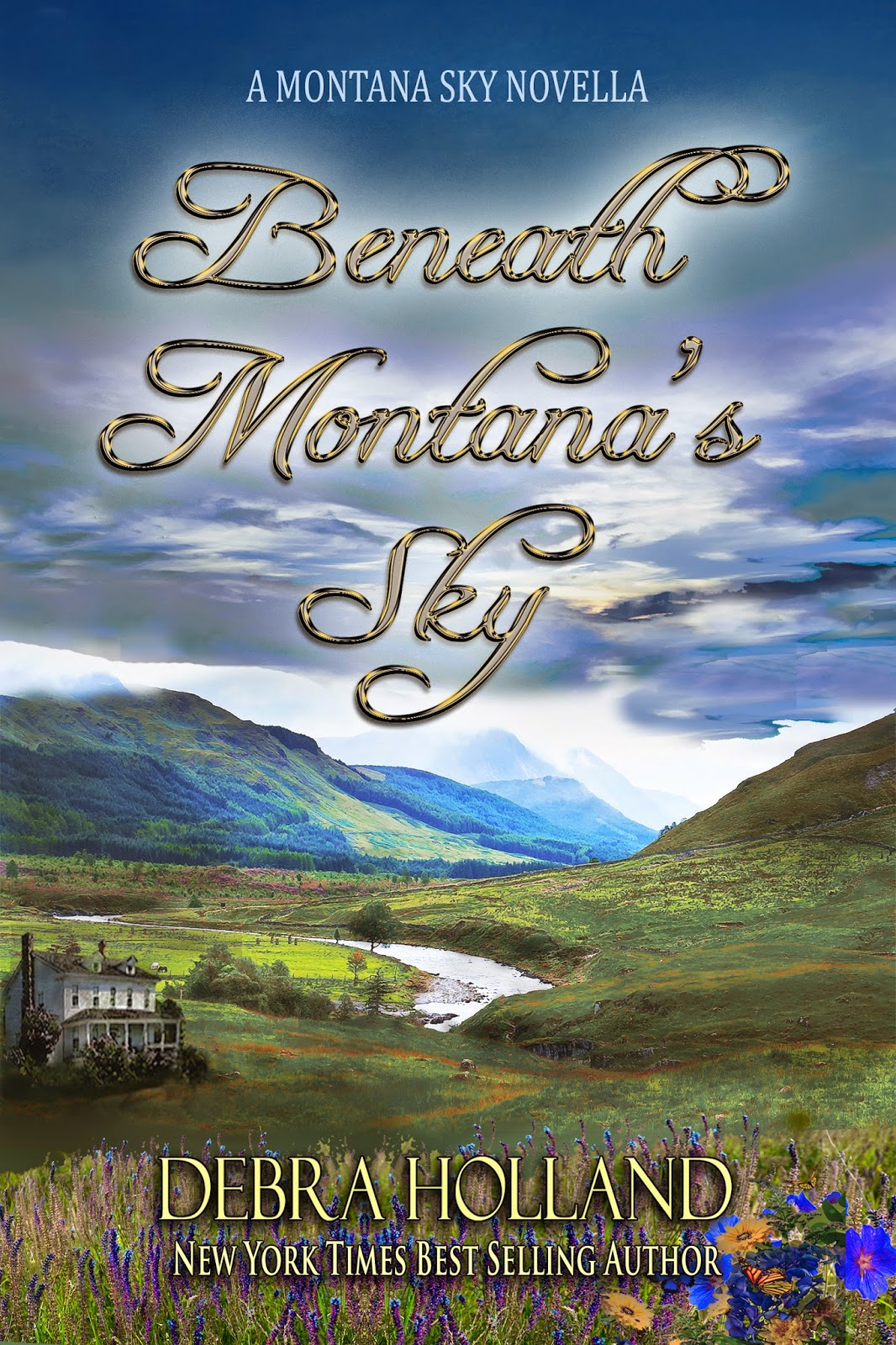
I loaded the cover on Nook. (I was at a conference at the time and was sleep deprived.) To my surprise, the book was live in three hours. The next day, while on the phone with Caroline Fyffe discussing our Mail-Order Brides of the West series, she mentioned that I had two different covers. Not knowing what she was talking about, I had to go look and each. Sure enough, the covers were different.
When I uploaded cover #2 on Amazon, my sales increased and the book went from having a sales rank in the 3000s to the current rank of #1500 overall in the Kindle store and #15 on the top 100 Western Romance list.
I love the new cover, although I'll probably have her make my name and New York Times Bestselling Author more visible.
Here was my cover:

Perfectly fine. What I didn't realize was that this wasn't the final version. When I recently went to upload the book to Nook (anticipating that I might need a couple of days for the book to go live) I found the cover was too big. So I requested a smaller version from my cover artist. She sent me this:
I loaded the cover on Nook. (I was at a conference at the time and was sleep deprived.) To my surprise, the book was live in three hours. The next day, while on the phone with Caroline Fyffe discussing our Mail-Order Brides of the West series, she mentioned that I had two different covers. Not knowing what she was talking about, I had to go look and each. Sure enough, the covers were different.
When I uploaded cover #2 on Amazon, my sales increased and the book went from having a sales rank in the 3000s to the current rank of #1500 overall in the Kindle store and #15 on the top 100 Western Romance list.
I love the new cover, although I'll probably have her make my name and New York Times Bestselling Author more visible.
Subscribe to:
Posts (Atom)
